
You know what your patient is feeling.
You know what the guideline recommends.
You know the diagnosis.
Now tell me what is producing the symptoms
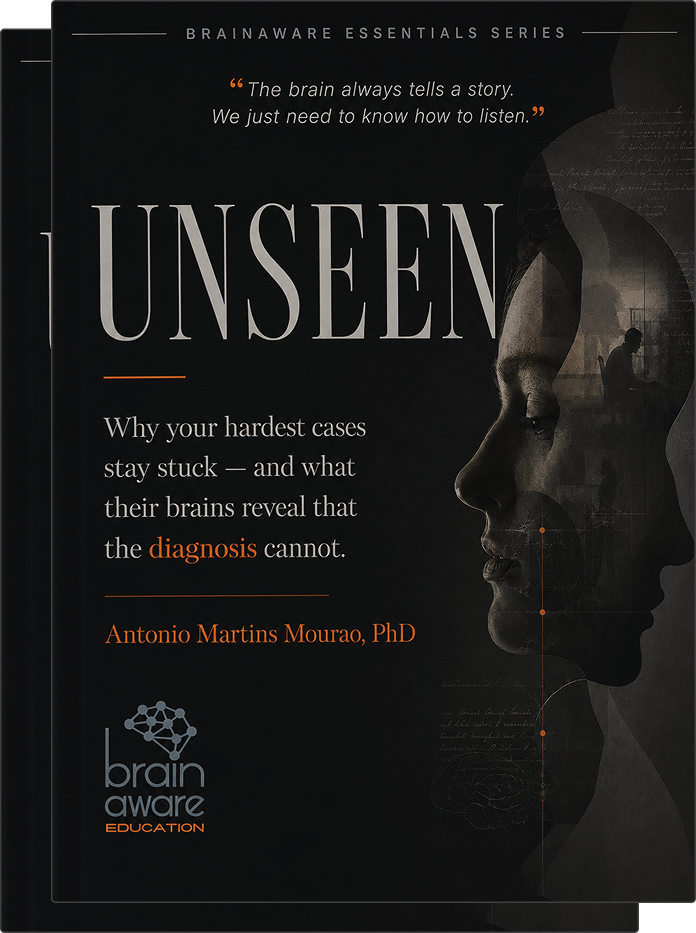
Send Me The UNSEEN Guide
Harder, isn't it?
That gap matters. Two patients can meet the same diagnostic criteria, receive equally appropriate care - and follow completely different clinical trajectories. The diagnosis may be right. The explanation may still be incomplete.
We call some patients treatment-resistant. But that tells us what happened. It does not, by itself, tell us why. What if, sometimes, treatment resistance tells us as much about the limits of what our current formulation can explain as it does about the limits of the patient?
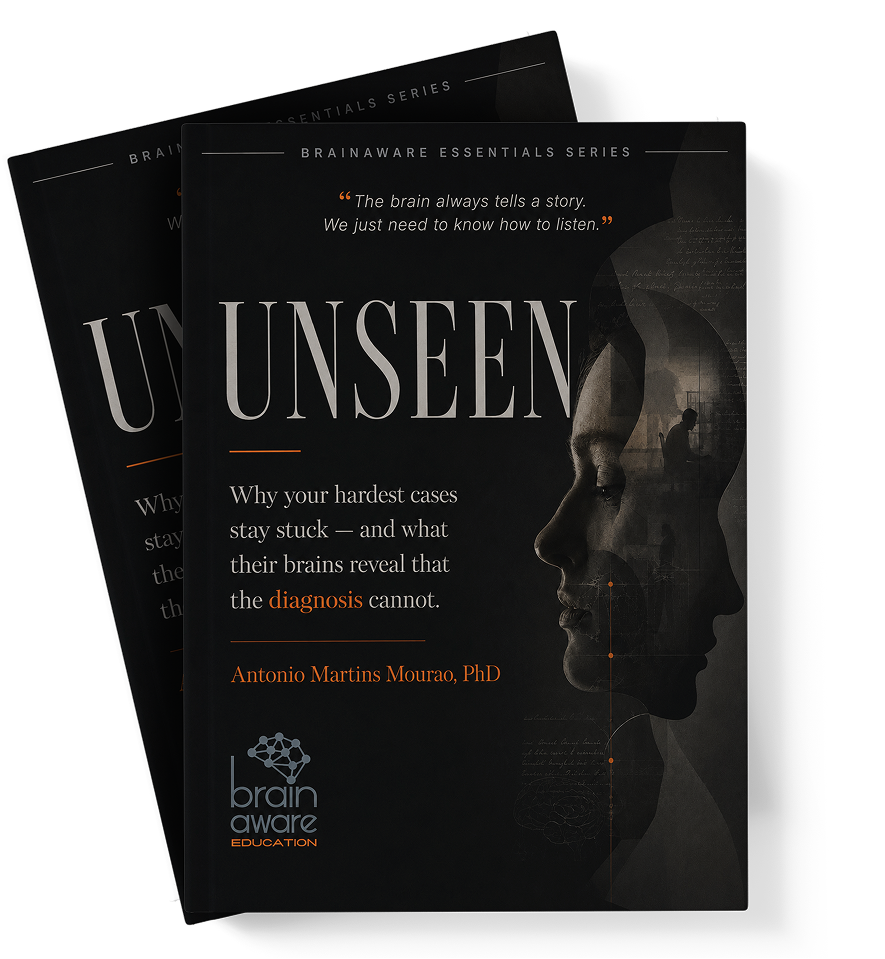
UNSEEN explores the gap between having named the suffering - and having understood what may be producing or maintaining it in this individual patient.
A diagnosis can be right. A formulation can be holistic. And the case can still be unresolved.
The difference between recognising a condition and explaining an individual case
Take a difficult patient you know well. You can describe the symptoms, development, relationships, context, beliefs, medication and treatment history. You may already have several plausible explanations for why the problem persists.
Now ask the harder question: what evidence would make you give one explanation more weight than another?
If that question is harder, you have found the gap Brainaware is interested in.
More information does not automatically create more explanation. UNSEEN explores how to move from a rich clinical picture towards a formulation that helps you decide between competing explanations.

After UNSEEN
discover your Clinical Thinking Profile
After you request UNSEEN, you can take a 4-minute Clinical Thinking Assessment. It is not a test of clinical competence and there is no pass or fail.

Add a Title
The Kind Of Question Your Formulation May Underuse

Add a Title
One Practical Question To Bring To Your Next Difficult Case

Add a Title
The Clinical Lens You Naturally Trust First

Add a Title
A Second Lens You Already Use

Why I built this
I started asking this question because of patients I could not fully explain.
The diagnosis made sense. The treatment made sense. The outcome did not.
Across more than 25 years of clinical work spanning psychology, psychophysiology and neuroscience - and training mental-health specialists since 2011 - that question became central to my work: What are we not yet seeing?
Brainaware grew from making that question clinically usable: integrating diagnosis, development, context, lived experience, physiology and functional brain information without losing the person inside the data.
Dr. Antonio Martins-Mourao, PhD
Clinical Psychologist & Neuro-psychophysiologist
Founder, Brainaware Education
PhD, University College London
Questions clinicians ask
Is UNSEEN Arguing Against Diagnosis?
Diagnosis remains clinically useful. UNSEEN asks what it may still leave unexplained in an individual case.
Are You Saying Holistic Formulation Is Not Enough?
Brainaware starts where good formulation can still become difficult: when several plausible explanations remain and you need to decide what would distinguish between them.
Do I Need QEEG Training?
Functional brain information is introduced as one possible source of evidence, not as a replacement for clinical reasoning.
Terms & Conditions | Privacy Policy | Disclaimer | Refund Policy
NRT: L-718421-J | Commercial Reg: 936243 C
Reg Address: Praca Rebes, 5, AD500 Andorra La Vella, Andorra
© 2026 Brainaware Education SL - All Rights Reserved.